
How to Match a Wedding Band to Your Engagement Ring: Fit First, Then Style
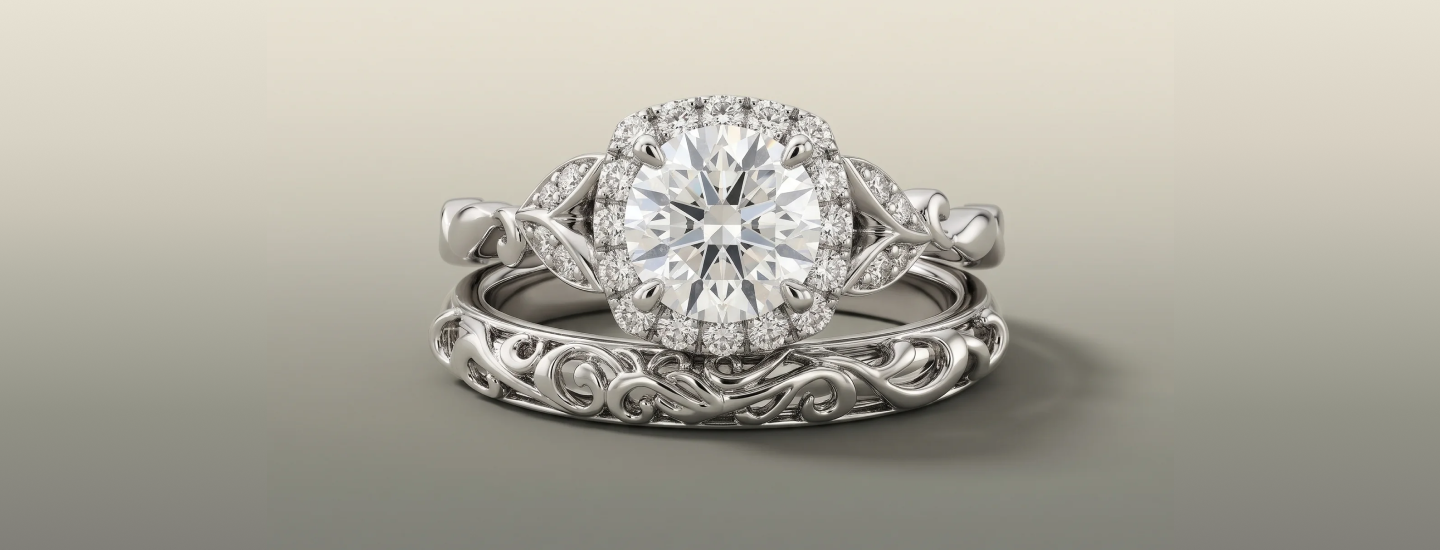
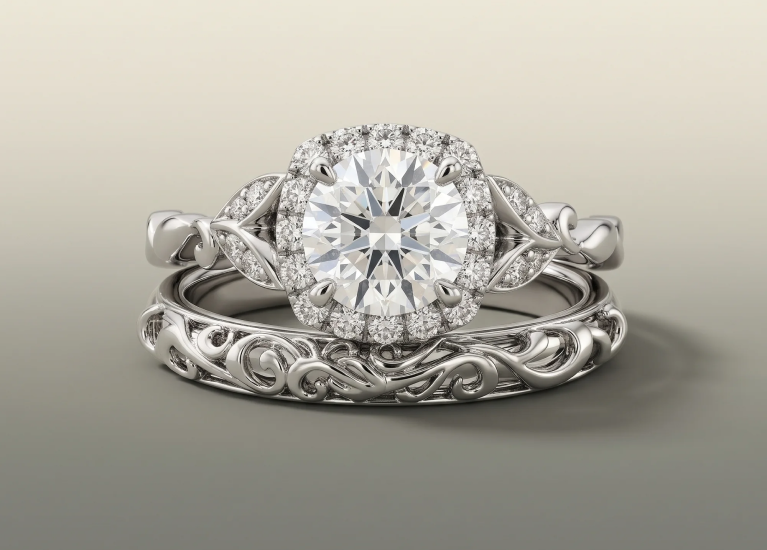
Most people choose a wedding band by looking straight down at it. The better test is to look at your engagement ring from the side.
A ring that looks perfect on its own can sit differently once a band joins it. The center stone may overhang the band, the two may leave a small gap, or the band may nudge the setting slightly off center. None of these is wrong, but each is easier to plan for than to discover after the ring is finished. That’s why we suggest choosing the band when you choose the ring: one metal decision, one size and one timeline, with a pair that sits the way you want from the first day.
The Ring Guide · 06
Swipe through the guide →
Here’s how to match a wedding band to your engagement ring, starting with fit and then moving to style.
Start With Fit: Read Your Ring From the Side
Hold your engagement ring at eye level and look at it in profile. Two things decide how a band will sit beside it.
Setting height
Some settings lift the center stone high enough for a straight band to slide underneath. Others hold the stone low to the finger, so the base of the setting drops close to where a band would rest. If you’re still choosing your ring, this is one more reason the setting decides how your ring wears.
What sits at the base
Halos, hidden halos and diamond-set shoulders all take up space at the base of the setting. A hidden halo, like the one on our Rania, sits beneath the center stone. You may not see it from above, but it still shapes the ring’s profile.
Three ways a pair can sit
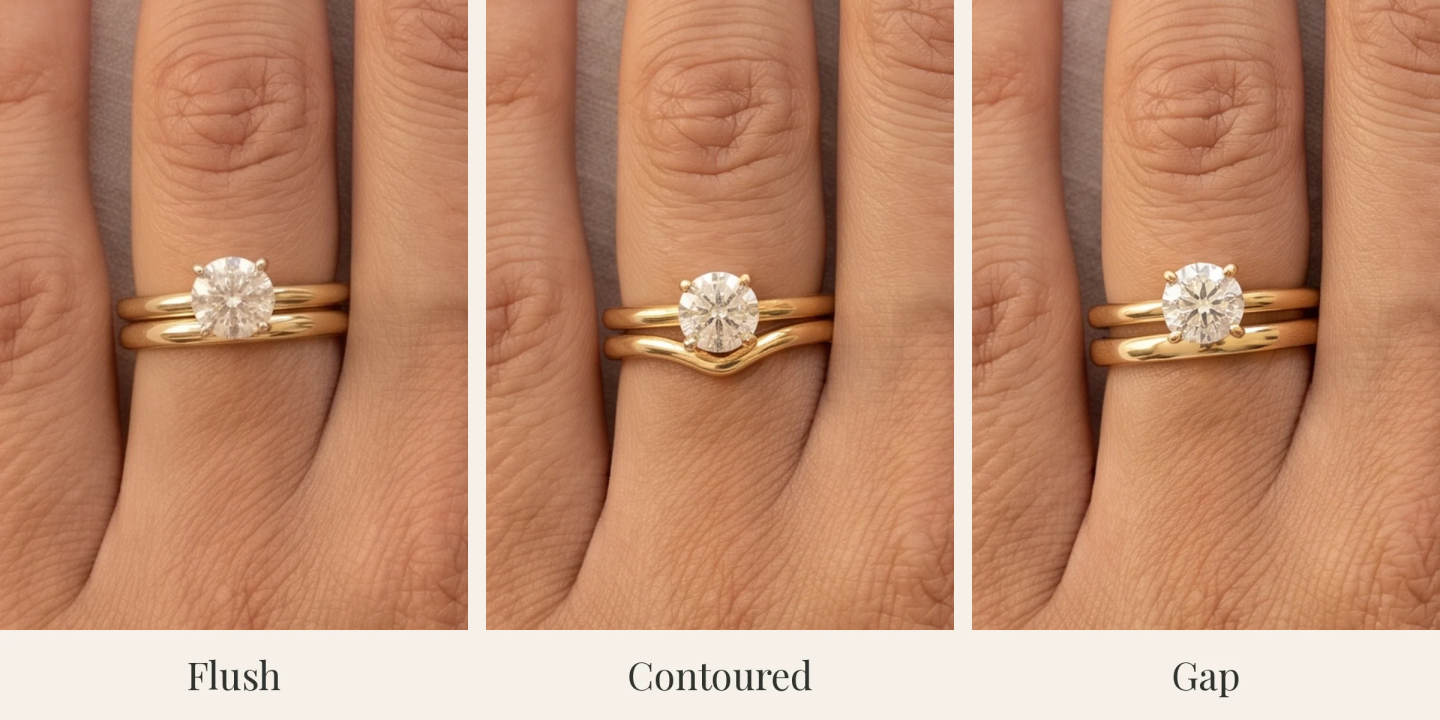
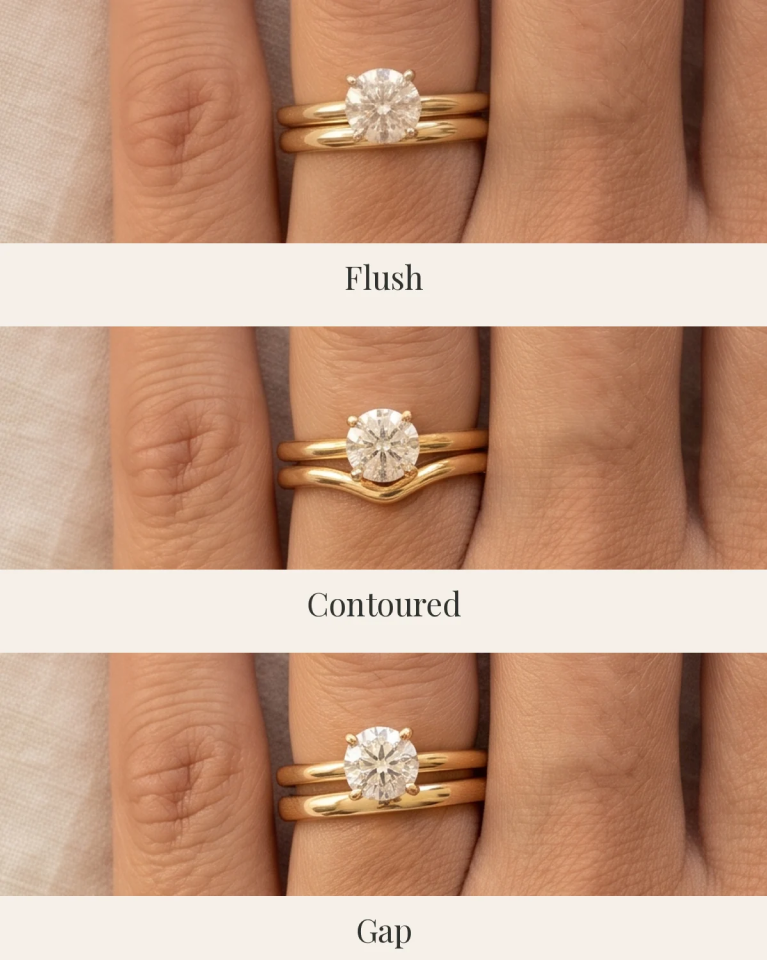
- Flush: the band rests directly against the engagement ring with no space between them.
- Contoured: the band curves around the center setting so the two rings meet along their length.
- Gap: a straight band sits beside a low setting, leaving a small space.
A flush or contoured pair reads as one piece. A gap reads as two rings worn together. Each is a choice. The point is to make it on purpose.
Contour or Straight: Which Your Ring Needs
A straight band is the simplest pairing, and it suits any ring whose setting leaves room for it. Every pairing below uses a straight band: in our set photos, Rania’s oval and Aida’s marquise rise above their bands, so Emily and Adaline sit right alongside them.
A contoured band is the answer when your center stone sits low or reaches out over the band and you’d rather the two rings met without a gap. It curves around the setting so nothing pushes the engagement ring off center.
If you love a straight band but your ring sits low, a small gap is a perfectly good answer too. Some people prefer it because it lets each ring stand on its own.
Plain, Channel, Half-Set or Eternity: How Much Sparkle Sits Beside the Stone
Once the shape works, decide how much the band should say.
Four band styles, side by side
| Style | How it looks | Choose it when | At SAMA |
|---|---|---|---|
| Plain metal | A clean line of polished gold or platinum | You want every bit of attention on the center stone | Phoebe 2mm |
| Channel-set | One even row of diamonds set in a channel | You want sparkle that stays orderly beside the stone | Emily |
| Half-set | Diamonds across the top, plain metal underneath | You want sparkle where it shows | Adaline |
| Eternity | Diamonds all the way around | You want the band to be a second statement | Layla |
- Plain metal keeps every bit of attention on the center stone. Our Phoebe 2mm has a rounded interior for a comfortable fit and is made to pair with any engagement ring.
- Channel-set bands line their diamonds up in one even row. Emily sets its diamonds in a channel, secured with small prongs, so the line stays neat beside the stone.
- Diamonds halfway around, as on Adaline, put the sparkle on top of the hand and leave plain metal underneath.
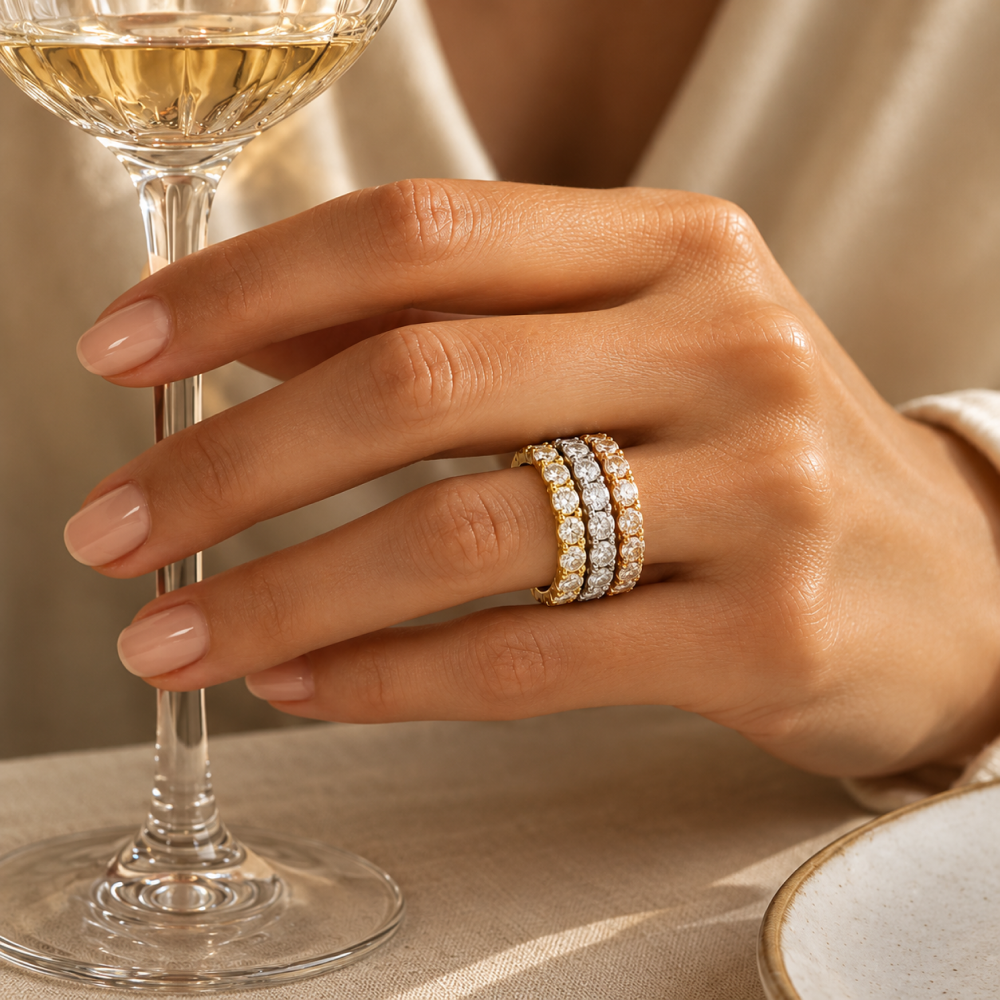
- Eternity bands circle the whole finger in diamonds.
When an eternity band makes sense
Choose an eternity band when you want the band to be a second statement rather than a quiet frame. Our Layla 2½ ct tw is set all the way around with your choice of lab-grown or natural diamonds. Because the diamonds continue around the whole band, each ring size carries a slightly different number of diamonds and a slightly different carat weight, so confirm your size with our size guide first.
Four Pairings Designed to Sit Together
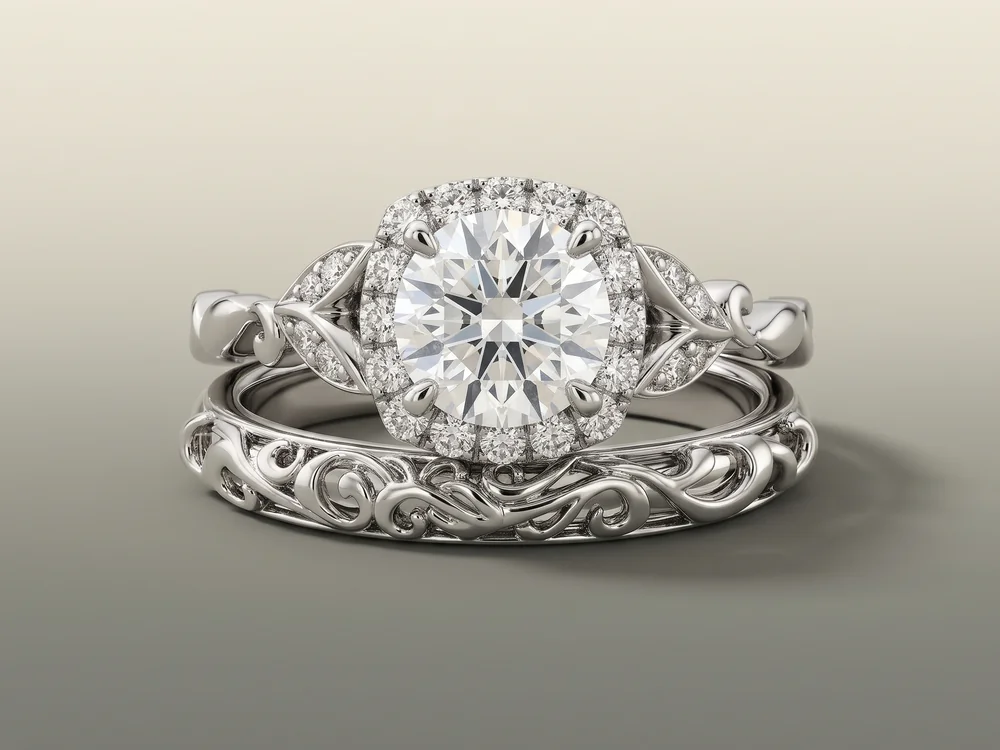
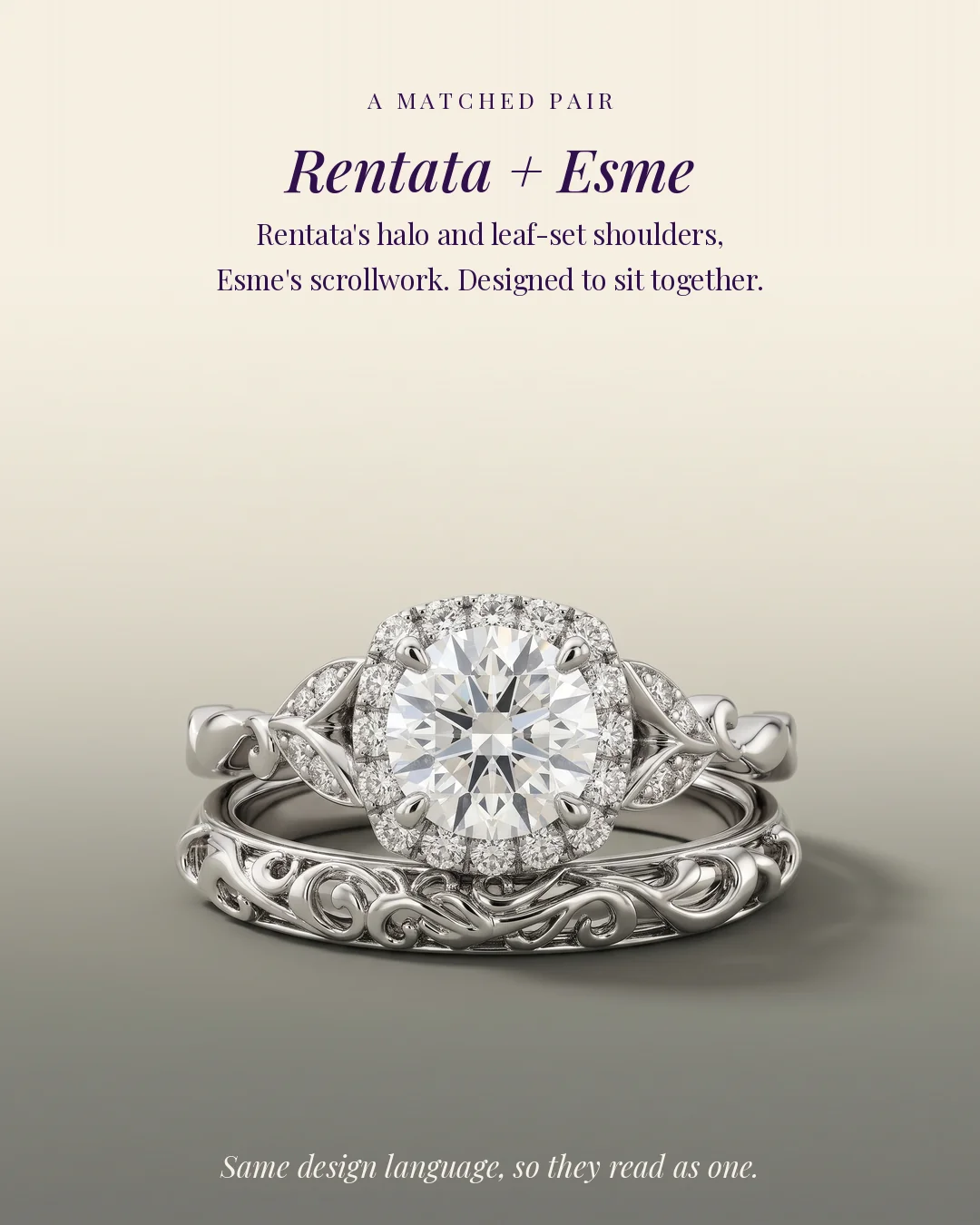
Rentata + Esme
A cushion-shaped halo on a leaf-set band, with a floral band designed to pair with it.
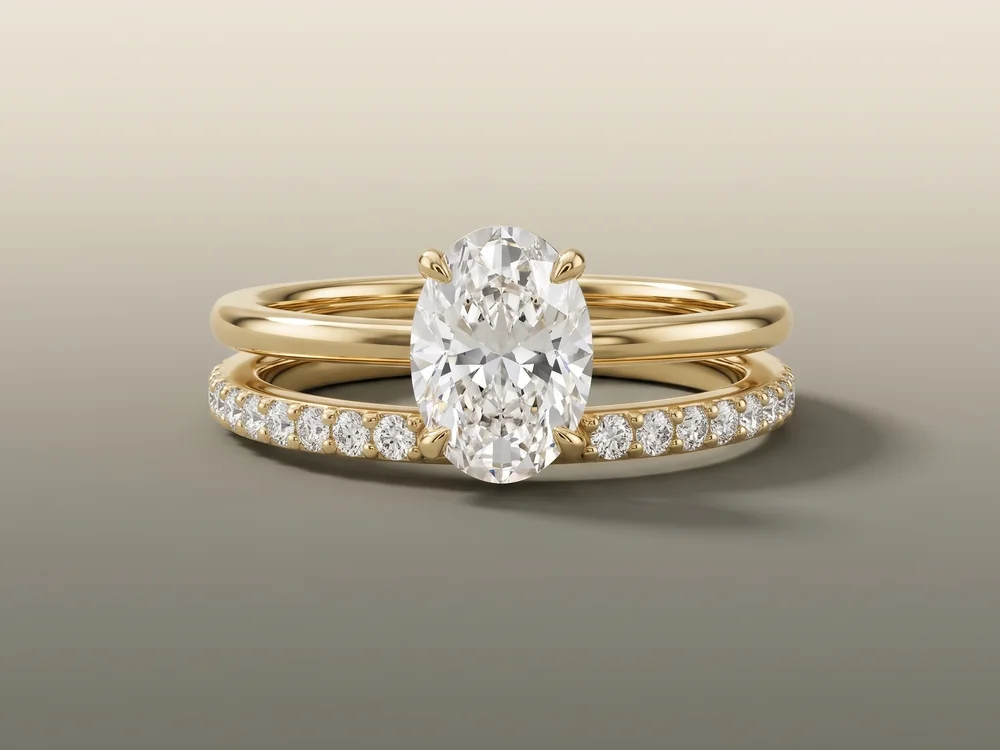
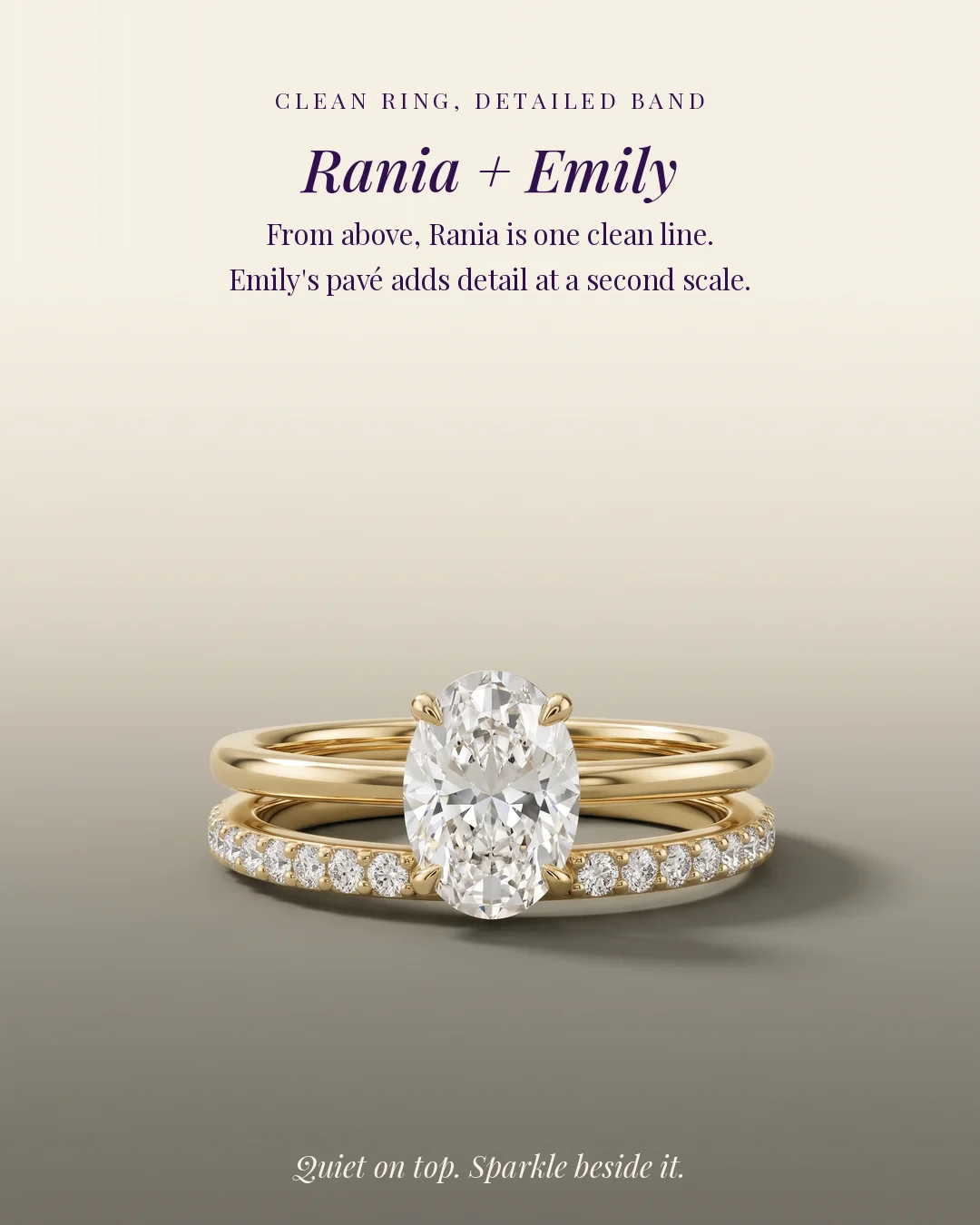
Rania + Emily
A clean oval on top, one straight row of diamonds beside it.
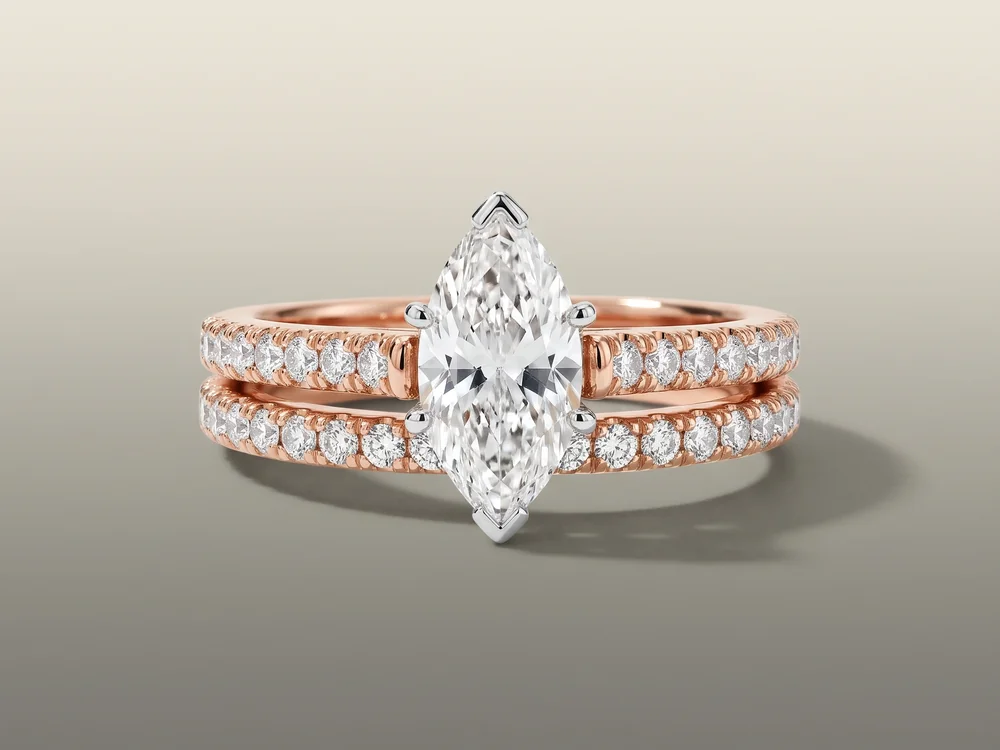
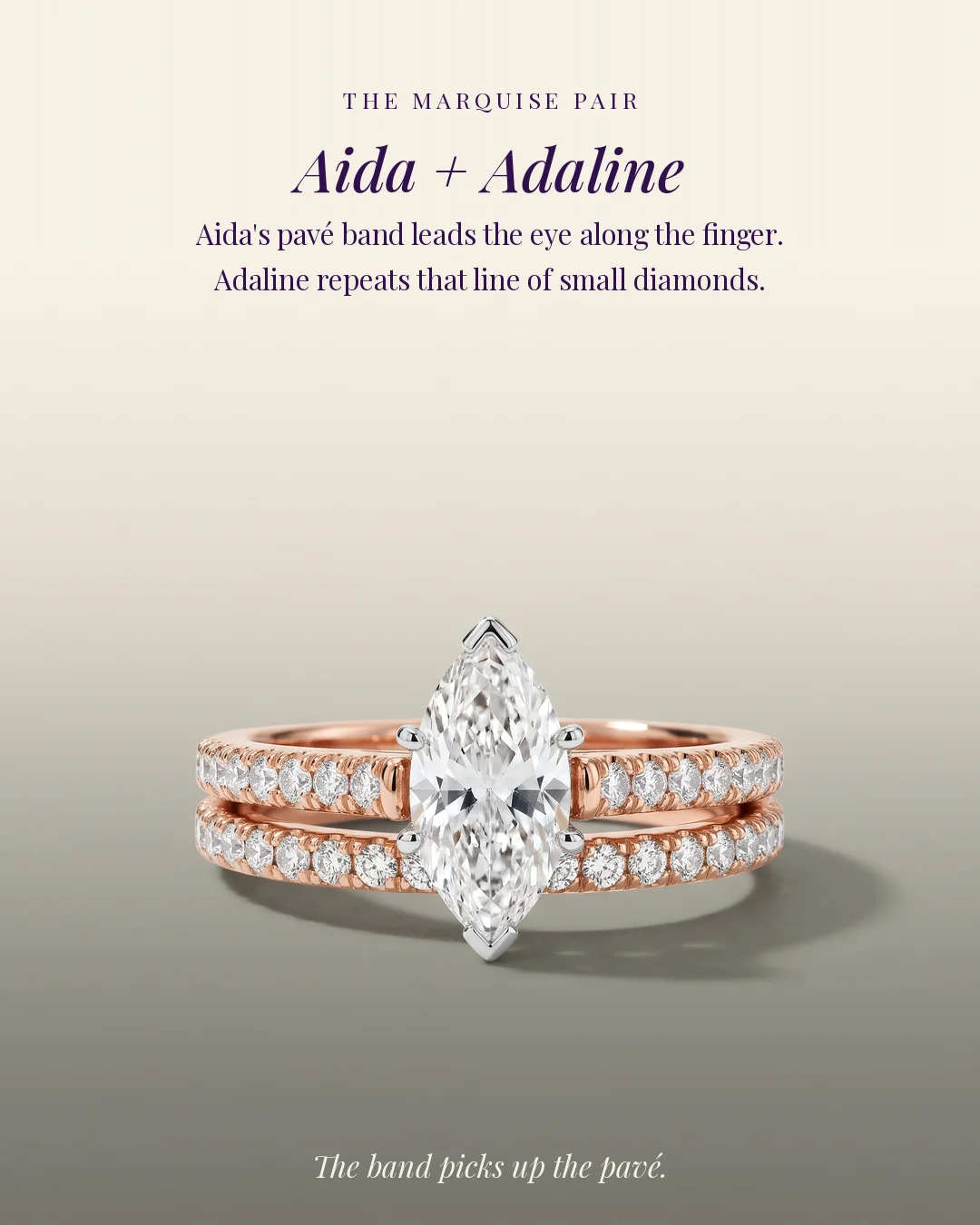
Aida + Adaline
Aida’s diamond-set band, repeated in the wedding band.

Layla, with almost anything
Diamonds all the way around, lab-grown or natural, beside a simple solitaire.
Rentata + Esme. Rentata frames a round center stone in a cushion-shaped halo, on a floral-inspired band with diamond-encrusted leaves. Esme was designed to pair with it and carries the idea into the wedding band with a floral motif of its own, so the two read as one garden rather than two rings.
Rania Grand + Emily. Rania holds an oval center stone over a hidden halo. Emily adds one straight row of diamonds that keeps the focus on the oval.
Aida + Adaline. Aida’s row of prong-set diamonds runs halfway around a slightly wider band. Adaline repeats that line with its own diamonds set halfway around, so the band picks up the sparkle of the ring.
Layla, with almost anything. Beside a simple solitaire, Layla turns the pair into a full circle of light.
Match Your Metal, or Mix It on Purpose
Matching metals make the pair read as a set. Mixing them, say a white gold band beside a yellow gold ring, reads as a stack, and it can be lovely when it’s deliberate. If you’re still weighing metals, our guide to choosing a metal you’ll still love in ten years explains how each one wears over time. For mixing and layering, see our wedding band stacking guide.
Order Them Together
Choosing both at once means one sizing, one metal decision and one delivery. Diamond pieces, including our diamond wedding bands, ship in 14 business days, and plain metal bands like Esme ship in 10.
Choose the band now. Thank yourself later.
Nearly 70 matching sets, each designed so the ring and band sit together.
Proposing at Thanksgiving? Order your ring and band together by Friday, October 30. And 1% of every sale goes to a cause you choose at checkout.
FAQs
Does my wedding band have to match my engagement ring?
No. It needs to fit comfortably beside your ring. Matching the metal or the style is up to you. Some people want the two to read as one set, and others prefer a deliberate contrast.
What is a contour wedding band, and do I need one?
A contour band curves to follow the shape of your engagement ring’s center setting, so the two rings sit close along their length. You only need one if your setting sits low enough that a straight band would leave a gap you’d rather not have.
Should I buy the wedding band at the same time as the engagement ring?
You don’t have to, but choosing them together lets you plan the fit, match the metal and size both rings at once. At SAMA, diamond pieces ship in 14 business days and plain metal bands in 10.
Can I wear an eternity band with my engagement ring?
Yes. Check how it sits against your setting first. Because diamonds circle the whole band, each size of an eternity band like Layla has a slightly different diamond count, so confirm your size before you order.
Can I add a wedding band later if I already have my engagement ring?
Yes. Look at your ring from the side to see how much room the setting leaves, then choose a straight band, a contoured band or a deliberate gap. A slim plain band like Phoebe 2mm pairs with any engagement ring, and our Matching Sets show the bands designed for specific SAMA rings.