
Buying Your Own Ring: A Guide for Women Who Aren't Waiting
You know the ring you want. You can afford it. And still, something makes you hesitate before buying it.
That hesitation usually isn't about the ring. It's about the absence of a script. Almost every convention around fine jewelry assumes someone else is involved — choosing it, paying for it, presenting it. There's no equivalent tradition for walking into it alone and deciding for yourself.
So the practical questions go unanswered. Which hand. What to spend. What to say when someone asks.


You're Not the Only One
The idea that fine jewelry arrives as a gift is now the exception rather than the rule.
A BriteCo survey of 2,000 Americans conducted in October 2025 found that 80% of adults are more likely to buy fine jewelry for themselves than wait to receive it — a figure that rises to 86% among people aged 30 to 44.
Numbers don't make a decision for you. But they do reframe one. If you've been treating buying your own ring as an unusual thing to do, it isn't — it's closer to how most fine jewelry is now bought. If you're interested in how that shift happened and what it's changed about design, we wrote about it in jewelry as everyday expression.
What You Know That a Gift-Giver Doesn't
Here's what tends to get lost in conversations about buying your own jewelry: you're better positioned to choose than almost anyone else would be.
Someone buying a ring for you is working from observation and guesswork. You're working from experience. You know which of your rings you actually reach for and which sit untouched. You know whether you take jewelry off to cook, type, swim, or sleep — and whether you'll remember to put it back on. You know if you're someone who notices a ring catching on a sleeve, or someone who never would.
You know what your hands do all day. You know whether you want something you'd have to think about, or something you'd stop noticing by the second week — and that either answer is a legitimate basis for a decision.
That's not a compromise. It's better information than a gift-giver has ever had.
A ring you choose for yourself isn't a substitute for anything. It's a decision you had better information to make.
The Practical Decisions
Which hand, which finger?
There's no rule, and conventions differ from place to place. In much of the US and Western Europe, the left ring finger is associated with marriage, which leads many people buying for themselves toward the right hand — the same finger, the other side, no explanation required.
But plenty of people wear a ring they bought themselves on the left hand, or on an index or middle finger where it reads clearly as a style choice. The only real consideration is practical: your dominant hand takes more wear, so a ring worn there will see more of daily life.
And what do you say when someone asks?
Whatever you like. I bought it for myself is a complete sentence, and it needs no follow-up.
It's worth deciding in advance only because being asked is easier when you're not composing an answer on the spot. Some people offer the occasion — a promotion, a birthday, the end of a hard year. Some name the ring itself. Plenty say nothing at all and change the subject, which is also a complete answer. None of these is more correct than the others, and no explanation is owed to anyone.
What should it cost?
When you're the one buying, no occasion sets the budget. There's no anniversary convention, no rule of thumb inherited from an engagement, no expectation to meet.
The more useful frame is how often you'll wear it. A ring you put on every morning for the next decade is a different calculation from one that comes out a few times a year — spread across daily wear, a piece of fine jewelry costs remarkably little per day it's actually on your hand. That reasoning tends to point toward buying something you'll live in rather than something you'll save.
Our Phoebe 2mm is a plain wedding band with a rounded interior, available in 18K white, yellow, and rose gold, and in platinum — $538 in gold. At that price it isn't a stand-in for a better ring later.

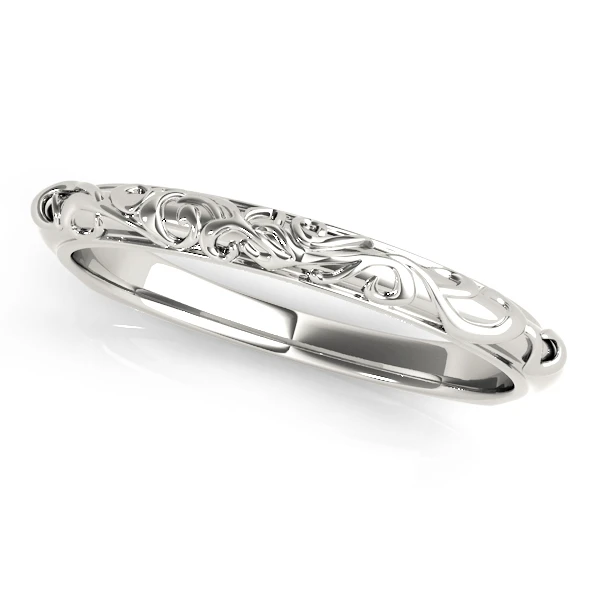
If you want something with more presence, Esme carries a raised, sculptural floral motif carved into the face of the band — detail with real dimension that catches light as your hand moves. At $775 in 18K gold, it's a ring that stands on its own without a stone.
Buying without a second opinion also makes the return policy worth reading before you order rather than after. Ours runs 30 days.
Plain, or something with detail?
Plain bands are the more flexible choice. They sit easily beside other rings, layer without competing, and stay quiet enough to wear through anything. A detailed band asks for more room but rewards it — it works as a single piece in a way a plain band usually doesn't.
If you think you'll add to it over time, our guide on how to stack wedding bands covers how rings work together. And because you won't have anyone else's guess to correct, it's worth getting the size right the first time — our size guide walks through how.
If Nothing Feels Right, Design It
Buying for yourself removes the two things that usually force a compromise: you don't need to keep it a surprise, and you don't need anyone else to agree.
That makes this the ideal circumstance for designing rather than selecting. With our ring builder, you can start with a setting, a diamond, or a gemstone — natural or lab-grown — and build from whichever end matters most to you. If the stone is the point, start there. If it's the shape of the band, start there instead.
And if what you want doesn't exist in any collection, Rock Your Way is our bespoke service for fully customizing your bridal jewelry.
What the Purchase Supports
Designing something entirely your own extends to what the purchase does after it leaves us.
SAMA gives 1% of every sale to nonprofit partners, and you choose which cause at checkout — organizations working on gender equality, LGBTQIA+ rights, youth and education equity, and mental well-being. You can see who we work with in our philanthropy partners directory.
Buy the Ring
The hesitation is a habit, not a reason. There's no ceremony required to buy something you'll wear every day, and no one whose permission is outstanding.
You already know what you want. And you know more about how you'd wear it — how it would fit your hands, your week, your life — than anyone choosing on your behalf ever could. That's not a consolation. That's the whole advantage.
Discover Rock Your Way to design something entirely your own — or explore our mission to see where your purchase goes.
FAQ's
Is it normal to buy your own ring?
A BriteCo survey conducted in October 2025 found 80% of adults are more likely to buy fine jewelry for themselves than wait to receive it.
Which hand should you wear a ring you bought yourself?
There's no rule; conventions vary. Many choose the right ring finger, though plenty wear it on the left or on another finger entirely.
What do you say when someone asks about a ring you bought yourself?
Whatever you like. No explanation is owed.